
A Guide to UK Fire Extinguisher Colours
05/03/2026
If you are responsible for fire safety in a UK property, understanding fire extinguisher colours is not just helpful—it is a fundamental part of your legal duty. While modern extinguishers are all signal red, the small coloured band on the cylinder is what tells you its type and purpose. Getting this wrong can have disastrous consequences.
As the designated ‘Responsible Person’ under the Regulatory Reform (Fire Safety) Order 2005, you are legally accountable for all fire safety measures on your premises. This includes ensuring the correct types of fire extinguishers are not only installed but are also correctly located and maintained.
This is not about guesswork. The type of extinguisher you need is determined by your fire risk assessment. This document identifies the specific fire hazards in your property—like electrical hubs, flammable liquids, or cooking equipment—and dictates which extinguishers are required to tackle those risks safely.
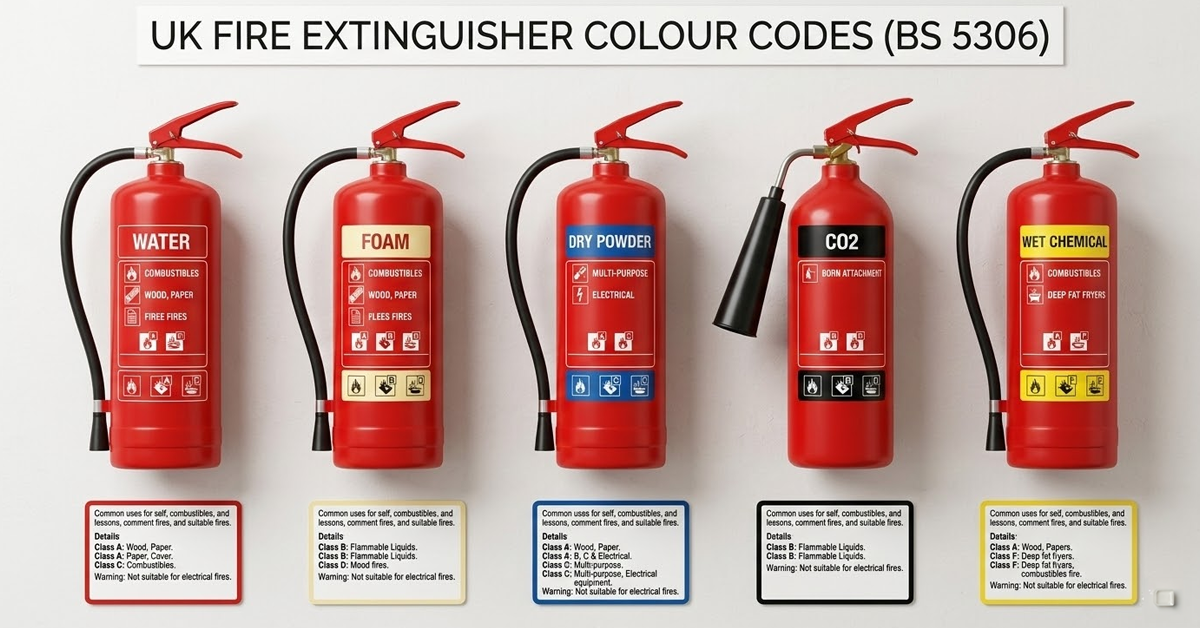
The colour-coded band is your instant guide to what is inside the extinguisher. A black band means you have a CO2 extinguisher for electrical fires, while a cream band signals a foam extinguisher for flammable liquids.
This guide will provide you with the practical knowledge to navigate the system with confidence. You will learn to:
For a deeper look at the specific models available, you might find our guide on which fire extinguishers are right for your property useful. Mastering this is the first step toward confident and proactive fire risk management.
If you have been managing properties for a while, you probably remember the days of solid blue, black, or even cream-coloured fire extinguishers. Today, however, almost every unit you will find is a uniform signal red. This was not an aesthetic choice; it was a crucial safety upgrade driven by major changes in British Standards.
The big shift happened back in 1997 when the current BS EN3 standard took over from the old BS 5423 rules. The new regulation stated that at least 95% of an extinguisher’s body must be signal red. Just a small panel, no more than 5%, could be used for the coloured band that tells you what is inside. This move brought the UK in line with the rest of Europe, getting rid of a patchwork system that could cause dangerous confusion in an emergency. You can discover more about the specific history of this regulatory change and its impact on UK fire safety.
So, why red? The reason is simple: visibility. In the chaos of a fire, every second counts. Red is the colour our brains are hardwired to associate with danger and emergencies, making extinguishers instantly recognisable.
More importantly, it is one of the last colours to fade from sight in a smoke-filled room. When visibility drops and panic sets in, being able to spot an extinguisher immediately can be the difference between a small, contained incident and a full-blown disaster. Standardising the main body to signal red means anyone can find this vital piece of equipment, no matter what type it is.
It is important to know that the new rule was not applied retrospectively. So, if you still have older, fully-coloured extinguishers on your property that were made to the old BS 5423 standard, they are not automatically illegal.
As long as an older, fully-coloured extinguisher is in good working order, has a complete service history, and has not reached the end of its serviceable life, it can remain in place.
However, the moment that extinguisher is used, fails a service, or reaches its expiry date, you must replace it with a new model that complies with the current BS EN3 standard. This practical approach allows older equipment to be phased out naturally over time, avoiding a sudden financial hit for property owners while ensuring every UK property gradually moves towards a safer, more unified system.
The bright red body of a modern fire extinguisher tells you one thing: it meets current safety standards. But it is the small coloured band wrapped around the top that tells you everything you actually need to know in an emergency.
As the Responsible Person for a property, you are legally required to provide the right type of extinguisher for the fire risks you have. Getting this wrong is not just a compliance issue; it can be disastrous. Using a water extinguisher on a chip pan fire, for instance, will not put it out—it will cause a violent, explosive fireball.
Understanding these colour codes is a fundamental part of your duty under the Regulatory Reform (Fire Safety) Order 2005. It is about ensuring that when someone grabs an extinguisher, it is going to help, not make things dangerously worse.
This table breaks down what each colour means, which fires it can be used on, and where it is a serious hazard.
| Colour Band & Type | Suitable for Fire Classes | DO NOT USE on Fire Classes | Common UK Property Location |
|---|---|---|---|
| (Solid Red) Water | Class A: Wood, paper, textiles, solids. | Electrical, Class B (liquids), Class F (oils). | Corridors, offices, storerooms with general combustibles. |
| Cream – Foam | Class A & Class B: Petrol, diesel, paint. | Electrical, Class F (oils). | Workshops, petrol stations, flammable liquid stores. |
| Black – CO2 | Electrical & Class B: Flammable liquids. | Class A (ineffective), Class F (oils). | Server rooms, offices with lots of electronics, switch rooms. |
| Blue – Dry Powder | Class A, B, C (gases) & Electrical. | Class F (oils). Generally avoid indoors. | Vehicles, garages, outdoor areas with mixed risks. |
| Yellow – Wet Chemical | Class F: Cooking oils, deep fat fryers. Also Class A. | Class B (liquids), Class C (gases), Electrical. | Commercial kitchens, canteens, restaurants. |
As you can see, there is no single extinguisher that does everything perfectly. Your fire risk assessment is the document that will tell you exactly which types you need and where to put them.
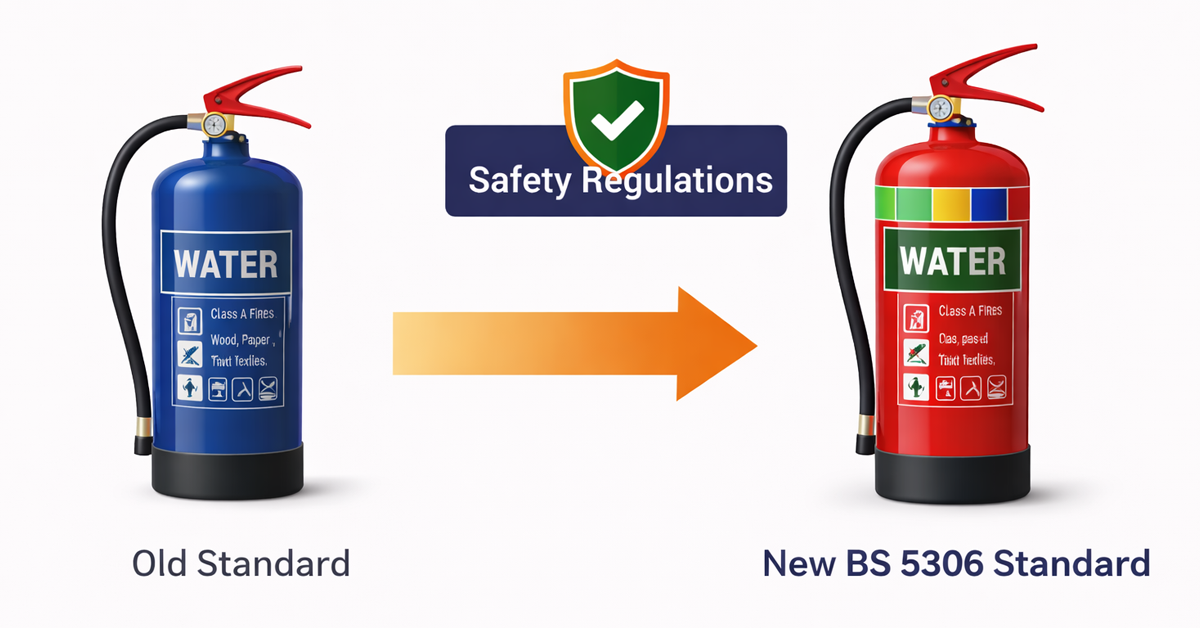
This shift to a standard red body was not just for looks. It was a crucial safety update to make extinguishers instantly visible in a smoky room, while the band provides the vital details on what is inside. Let’s look at each one more closely.
The classic water extinguisher is identified by a solid red band, or often no band at all on an all-red cylinder. These are your go-to for Class A fires—those involving solid combustible materials like wood, paper, or textiles.
They are the most common and cheapest type of extinguisher, perfect for offices, school corridors, and stockrooms where general combustibles are the main risk. Just remember their limits. Never use them on electrical fires, kitchen pan fires, or flammable liquids.
A cream band signals a foam extinguisher. These are a great all-rounder for many environments. The foam creates a cooling blanket that smothers the fire and seals in the flammable vapours, preventing it from re-igniting.
This makes them ideal for both Class A (solids) and Class B (flammable liquids like petrol or paint) fires. You will often find them in workshops, garages, and warehouses. However, they are not suitable for kitchen fires (Class F) and should be avoided on significant electrical fires.
If you see a black band, you are looking at a Carbon Dioxide (CO2) extinguisher. These are specialist units designed for one primary purpose: fighting fires involving live electrical equipment.
The CO2 gas works by displacing oxygen, effectively suffocating the fire without leaving any residue. This is perfect for protecting delicate electronics like servers, computers, and switchgear. While also effective on Class B liquid fires, they are useless on Class A fires and can be dangerous in small, unventilated rooms as the gas can cause asphyxiation.
A blue band indicates a dry powder extinguisher, often nicknamed an ‘ABC’ extinguisher for its ability to tackle Class A, B, and C (flammable gas) fires. They are true multi-purpose units and can also be used on electrical fires.
So why are they not used everywhere? The powder creates a thick, messy cloud that severely impairs vision and can cause breathing problems. This makes them completely unsuitable for most indoor spaces like offices or homes. The powder is also corrosive and will permanently damage electronics. They are best left for outdoor areas, vehicles, and workshops with good ventilation.
The yellow band identifies a wet chemical extinguisher. These were specifically developed to handle the extreme heat and unique chemistry of Class F fires—those involving cooking oils and deep-fat fryers.
The wet chemical agent reacts with the burning oil in a process called saponification, creating a soapy layer that cools and smothers the fire. It is the only extinguisher you should have in a commercial kitchen. While also effective on Class A fires, it should not be used on flammable liquid or gas fires.
You might wonder why we need to look back at old fire extinguisher colours. The answer is simple: you will almost certainly find older, non-compliant extinguishers in properties you inspect, and knowing their history is the key to spotting them.
Understanding this history is not just trivia; it is a crucial part of your legal duty as a landlord or manager. It helps you identify outdated, and sometimes dangerous, equipment on the spot.
Back in the 1950s, Britain began to standardise extinguisher colours. This evolved into a system where the entire body of the extinguisher was painted a specific colour to show what was inside. Many experienced property managers will still remember the old solid cream (foam), solid blue (powder), and solid black (CO2) units.
This distinctly British system was completely overhauled in 1997 with the adoption of the European BS EN3 standard. This move was about harmonising safety rules across Europe, but it brought a massive visual change to the UK.
The new rule was simple: all new extinguishers had to have a “signal red” body. This was not just an administrative tweak. The goal was to make any fire extinguisher instantly recognisable as safety equipment, even in a panic or in low-visibility conditions like a smoke-filled room. The contents would now be identified by a small coloured band.
There’s one colour from this era you must be particularly wary of: green. Green extinguishers contained Halon, a highly effective fire suppressant. However, it was found to be incredibly damaging to the ozone layer. As a result, Halon extinguishers were banned, a process that came into full effect in 2003. If you ever find a green extinguisher, it is illegal, obsolete, and must be disposed of as hazardous waste.
The journey from fully-coloured cylinders to today’s red-bodied extinguishers is a story of making fire safety clearer and more universal. The old British system was a good first step, but the BS EN3 standard introduced in the 1990s created an unmistakable visual cue that works for everyone, everywhere.
This transition is a vital piece of compliance knowledge. While early efforts at standardisation began as far back as September 1951, the BS EN3 update marked the most significant change. You can read more about the detailed evolution of extinguisher colours in Britain on the FIA website.
For any Responsible Person, this history is a practical tool for property audits. Spotting an old, fully-coloured extinguisher that is well past its service date—or worse, an illegal Halon unit—is a direct benefit of knowing this background. It drives home why you must stick rigidly to the current system to keep your properties, and the people in them, safe.
Knowing your fire extinguisher colours is one thing, but putting that knowledge into action is what keeps your property compliant and your occupants safe. As the Responsible Person, it is your legal duty to get this right. The stakes are incredibly high—fail, and you could face unlimited fines, prosecution, voided insurance, and most importantly, put lives at risk.
This is not about ticking boxes. It is about building a robust fire safety system. This checklist gives landlords, HMO managers, and anyone in charge of a property a straightforward way to audit their buildings and prove they are taking their responsibilities seriously.
Your Fire Risk Assessment (FRA) is the blueprint for your entire fire safety strategy. It is not just a set of recommendations; it is a legal document that dictates precisely what you need to do to keep your building safe.
Start here. Go through your FRA and find exactly which types of extinguishers it specifies for each location. A good assessment will have mapped out the hazards—like electrical cupboards, kitchens, or storage areas—and matched them with the correct extinguisher. That, in turn, tells you which fire extinguisher colours should be on display. If your FRA is old, out of date, or vague about extinguishers, you need to get it reviewed by a competent person immediately.
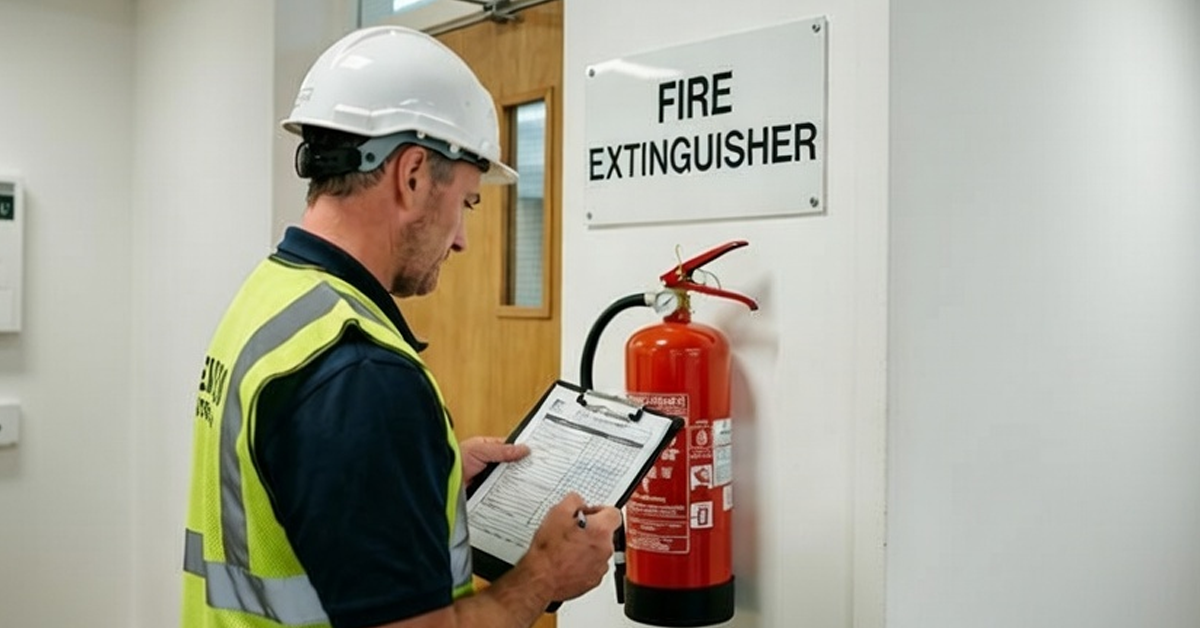
With your FRA in hand, it is time to walk the property. You need to physically check every single extinguisher to make sure what is on the wall matches what is on the paper.
An extinguisher without the correct sign above it is not compliant. It is that simple. The Regulatory Reform (Fire Safety) Order 2005 makes it clear that a Fire Extinguisher ID Sign must be installed directly above every unit.
This sign is not optional. It has to show the extinguisher type and use clear pictograms to show which fires it is safe to use on—and, crucially, which it is not. In the heat of the moment, this sign gives the instant guidance someone needs to avoid grabbing the wrong extinguisher and making a bad situation dangerously worse.
Finally, you need to have a solid servicing schedule in place and stick to it. Every fire extinguisher in a tenanted or commercial property must be serviced annually by a competent engineer. This is a non-negotiable legal duty. You can read more on your duties in our full guide to fire extinguisher maintenance requirements.
Keep a detailed logbook of all your inspections, maintenance visits, and any action taken. This paperwork is your proof of due diligence if the Fire and Rescue Service comes to inspect your property. Following these steps methodically is the best way to manage your risk and meet your legal obligations with confidence.
If you are the ‘Responsible Person’ for a UK property, getting to grips with fire extinguisher colours is not just good practice—it is a core part of your legal duties. The takeaways are straightforward but absolutely critical for protecting both people and your property.
When it comes to choosing the right extinguisher, your decision should always be guided by your official Fire Risk Assessment. This is the document that maps out the specific fire hazards on your premises and tells you exactly what equipment you need to deal with them.
And once they are installed, do not forget that regular maintenance is a non-negotiable legal requirement. You must have every single unit serviced once a year by a competent professional to stay on the right side of the law.
At the end of the day, compliance is not just about ticking boxes to avoid a fine from the Fire and Rescue Service. It is about building a solid foundation that protects lives, prevents catastrophic property damage, and keeps your business or rental property running smoothly.
The goal is to get to a place where you can manage your fire safety duties with confidence. Armed with this knowledge, you can act as a capable and diligent duty holder, making sure your premises are safe for everyone.
Remember, fire safety does not exist in a vacuum. It is part of a much bigger picture of effective property management. For a wider perspective, this guide to residential property management offers some great insights into keeping your property compliant and safe overall. But whenever you are in doubt, your first port of call should always be your risk assessment and, if needed, a fire safety expert.
To wrap things up, let’s tackle some of the most common questions we hear from landlords, business owners, and property managers. Getting these details right is key to fulfilling your duties as the Responsible Person and staying on the right side of the law.
It is a great question. The short answer is yes, but only if they were made before 1997 to the old BS 5423 standard, are still in good condition, and have a perfect service history. Their colour alone does not make them instantly illegal.
However, the moment they are used, fail a service inspection, or simply reach their end of life, any replacement must be a modern, predominantly red extinguisher that complies with the current BS EN3 standard. This ensures a gradual, managed shift to the safer, universally recognised equipment.
Absolutely. UK regulations are crystal clear on this: every single extinguisher must have a Fire Extinguisher ID Sign positioned correctly above it. This is not just best practice; it is a non-negotiable legal requirement.
The sign needs to show the extinguisher’s type, which fire classes it is safe to use on, and—just as importantly—what it should never be used on. In the heat and confusion of an emergency, that at-a-glance guidance is absolutely critical.
This is the most important question of all, and the answer always comes from your Fire Risk Assessment (FRA). This legal document is the absolute cornerstone of your fire safety plan.
A proper FRA does not just guess; it methodically identifies the unique fire hazards in your property. It looks at everything from electrical switch rooms and commercial kitchens to areas where you might store flammable liquids. Based on those specific risks, it will tell you exactly what type of extinguisher (and therefore, what colour band) you need to have in place. Following your FRA is the only compliant way to choose your equipment.
You might occasionally still spot one of these in an old, forgotten corner of a building. The old green fire extinguisher contained Halon gas, which was a very potent extinguishing agent. The problem? It was found to be incredibly damaging to the Earth’s ozone layer.
Due to these severe environmental concerns, Halon extinguishers were banned in the UK back in 2003. If you come across one on your property, it is completely obsolete and must be disposed of correctly as hazardous waste by a specialist contractor.
Beyond just the equipment, a truly proactive fire safety strategy also means understanding broader issues like reducing fire hazard in vulnerable communities.
Most HMO landlords I talk to can rattle off their fire door requirements, their alarm grade, and their emergency lighting checks without missing a beat....

Most of the fire safety advice on this site assumes you already have a working HMO. This one is for the stage before that: the...