
A Guide to UK Fire Assembly Point Requirements
05/03/2026
A fire assembly point is far more than just a sign on a post; it is the designated place of safety that represents the final, crucial step in a successful building evacuation. Its entire purpose is to provide a pre-planned location, well away from the immediate dangers of a fire, allowing the ‘Responsible Person’ to conduct an accurate roll call and confirm everyone is accounted for.

When a fire alarm sounds, a clear and well-rehearsed evacuation plan is your single most effective tool for protecting lives. The final destination of that plan is the fire assembly point, a non-negotiable part of any commercial fire safety strategy in the UK.
Think of it as the organised conclusion to your emergency procedure. Without a designated assembly point, an evacuation can quickly descend into chaos. People might scatter, gather in unsafe spots too close to the building, or worse, try to re-enter the premises to find colleagues, putting themselves in extreme danger.
Establishing a safe assembly area is a core legal duty for the ‘Responsible Person’ under the Regulatory Reform (Fire Safety) Order 2005. While the law does not use the exact phrase “fire assembly point,” it absolutely requires you to create safe emergency procedures, and a clear assembly point is a logical and necessary part of that.
Its main functions are to:
Failing to establish this point of safety can have severe consequences. Perhaps the most dangerous outcome is that the Fire and Rescue Service may be forced to risk their own lives entering a burning building to search for people who are actually safe, just unaccounted for. This vital information, relayed from a successful muster at the assembly point, saves precious time and prevents firefighters from taking unnecessary risks.
During the stress and confusion of a real fire alarm, people need clear, simple instructions. A well-communicated fire assembly point provides that certainty and direction when it is needed most. It turns a disorganised crowd into an orderly group, making the task of accounting for everyone far more manageable.
The core purpose of a fire assembly point is to confirm that everyone who was inside a building is now safely outside. This simple check is one of the most important pieces of information you can give to the fire brigade upon their arrival.
Ultimately, this designated location supports the two primary goals of any fire safety plan: protecting life and managing the emergency efficiently. Without one, your evacuation plan is dangerously incomplete, and your ability to ensure everyone’s safety is seriously compromised. It is not a box-ticking exercise; it is a practical, life-saving component of your legal fire safety duties.
In the UK, fire safety is not just good practice—it is a strict legal duty. The foundation of this requirement is the Regulatory Reform (Fire Safety) Order 2005, which makes it crystal clear who is accountable for keeping people safe from fire. It places this huge responsibility squarely on the shoulders of a designated ‘Responsible Person’.
This means if you own, manage, or otherwise have control over a commercial building, an HMO, or the shared parts of a block of flats, you are legally responsible for the safety of every single person inside. A core part of that duty is planning for emergencies, and a fundamental piece of any emergency plan is a safe and effective evacuation procedure. A well-marked fire assembly point is not just a recommendation; it is an expected part of that plan.
The law has moved away from a simple box-ticking exercise. Instead, it demands a risk-based approach, forcing you to think critically about your specific property, the people using it, and the unique fire risks they might face.
Before you can comply, you have to know if the law is talking about you. Figuring out who the Responsible Person is depends entirely on the type of property.
In many buildings, this responsibility is shared. Think of a multi-tenanted office block: the building manager is responsible for the corridors, lifts, and stairwells, while each individual business owner is responsible for their own office. In these situations, clear communication is absolutely vital. You can dive deeper into the specific legal frameworks in our complete guide on UK fire safety regulations.
The Fire Safety Order states that the Responsible Person must complete a “suitable and sufficient” fire risk assessment. This is not just about filling out a form; it is the bedrock of your entire fire safety strategy and must be used to create your emergency plan.
That plan needs to detail exactly how people will be alerted to a fire and what they need to do to get out safely. A fire assembly point is the natural endpoint of every single escape route. Without one, your evacuation plan is dangerously incomplete and fails to meet the spirit—and most likely the letter—of the law.
An effective emergency plan, from an inspector’s point of view, is one that has been thought through from the sound of the alarm to the final roll call. Your assembly point is the critical location where that final, life-saving check happens.
Ignoring these responsibilities can have devastating legal and financial outcomes. Local Fire and Rescue Authorities have the power to inspect your premises and enforce the law. If they find your emergency plans are not up to scratch, the consequences can be severe.
This could start with an informal notice asking for improvements, but it can quickly escalate to a formal enforcement notice that legally forces you to fix the safety problems. For very serious risks, they can issue a prohibition notice, which could restrict access to or even completely shut down your building until it is made safe.
Failing to comply can lead to unlimited fines in GBP (£) and, in the worst cases, a prison sentence. A key part of proving you have met your duties is having solid documentation, so it is vital to understand the best practices for managing audit evidence. Ultimately, these laws exist for one simple reason: to save lives. A well-planned and clearly marked fire assembly point is a non-negotiable part of that responsibility.
Choosing the right location for your fire assembly point is not a quick guess—it is one of the most practical and important decisions a Responsible Person will make. The goal is to find a place of ‘total safety’, a spot that completely removes people from both the immediate and secondary dangers of a fire.
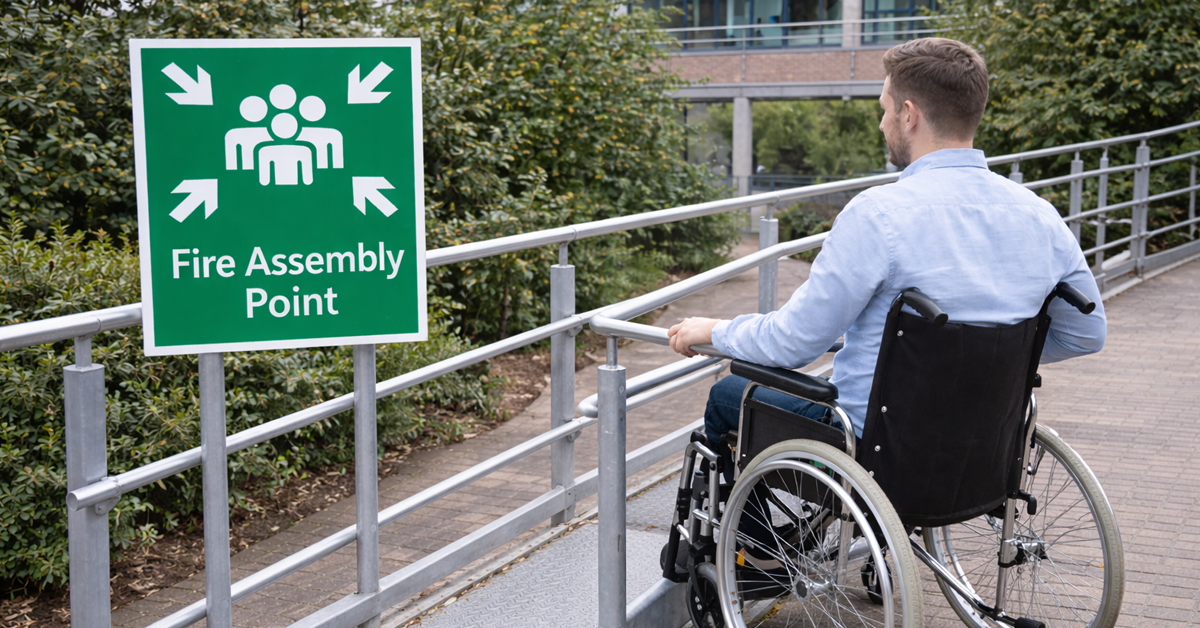
This selection process needs to be deliberate and documented within your fire risk assessment. Simply picking a corner of the car park is not good enough and certainly will not stand up to scrutiny. A properly chosen assembly point is both compliant with the Fire Safety Order and genuinely safe for everyone in your building.
First things first: distance. An assembly point that is too close to the building puts evacuees at risk from radiant heat, thick smoke, and, in a worst-case scenario, falling debris or even structural collapse.
A widely accepted rule of thumb is to position the assembly point at a distance of at least one and a half times the height of the building. This simple guideline helps ensure that if the building’s structure is compromised, everyone who has evacuated is well clear of the danger zone.
For a four-storey office block that is around 12 metres high, the assembly point should be at least 18 metres away.
Your chosen location must be easy and safe for everyone to get to, including people with disabilities or mobility challenges. This is not just good practice; it is a crucial part of your legal duty.
The route from the final exit to the assembly point should be clear, well-lit, and free from any obstacles.
Think about these factors:
Making sure the route is safe and accessible is a key part of the practical steps of a fire risk assessment, as it validates your entire evacuation strategy.
Your fire assembly point is the final link in the chain of survival. If any person, regardless of their mobility, cannot reach it safely, then the evacuation plan has failed. It must be a destination that is truly reachable by all.
Now, you need to think like the Fire and Rescue Service. When they arrive, the last thing they need is their access blocked by the very people they have come to rescue.
Your assembly point must be positioned so it does not get in their way. This means keeping it well clear of:
This kind of foresight is critical. A badly placed assembly point can cause life-threatening delays, stopping firefighters from getting to the blaze and carrying out search and rescue operations.
The “perfect” fire assembly point is completely dependent on your environment. What works for an industrial estate would be a total non-starter for a city-centre office.
To help you think through the options, here is a simple checklist for evaluating potential locations.
Use this checklist to evaluate potential locations for your fire assembly point to ensure they meet key safety and accessibility criteria.
| Consideration | Why It Matters | Good Example | Poor Example |
|---|---|---|---|
| Sufficient Distance | Protects evacuees from heat, smoke, and building collapse. | A point 1.5x the building height away, in an open area. | Directly across the street from the main entrance. |
| Clear Access Route | Ensures everyone, including those with mobility issues, can reach it safely. | A flat, well-lit pavement with dropped kerbs. | A route across a grassy, uneven field or up a flight of stairs. |
| Away from Hazards | Prevents evacuees from being exposed to new dangers. | A designated area in a quiet park or a staff car park. | Next to a busy main road, a riverbank, or a chemical storage area. |
| No Obstruction | Keeps access clear for the Fire and Rescue Service. | The far corner of a car park, away from hydrants and entrances. | In the middle of the site’s main access road. |
| Sufficient Space | Allows for an accurate headcount and prevents panic or crowding. | A large, open paved area that can hold all building occupants. | A narrow pavement that forces people to spill into the road. |
| Good Lighting | Ensures visibility and safety, especially at night or in poor weather. | An area covered by existing streetlights or dedicated floodlights. | A dark, unlit corner behind another building. |
Choosing the right spot requires careful thought, but this framework makes it a much more straightforward process.
Ultimately, every choice must be justified and written down. This documented rationale proves to any inspecting authority that your decision was based on a thorough assessment of the unique risks at your specific property.
A perfectly chosen fire assembly point is completely useless if nobody knows where it is or how to get there. Clear, unambiguous communication is not just a good idea; it is a fundamental part of your legal duties under the Regulatory Reform (Fire Safety) Order 2005. The process starts with the right signs but has to be baked into your building’s entire safety culture.
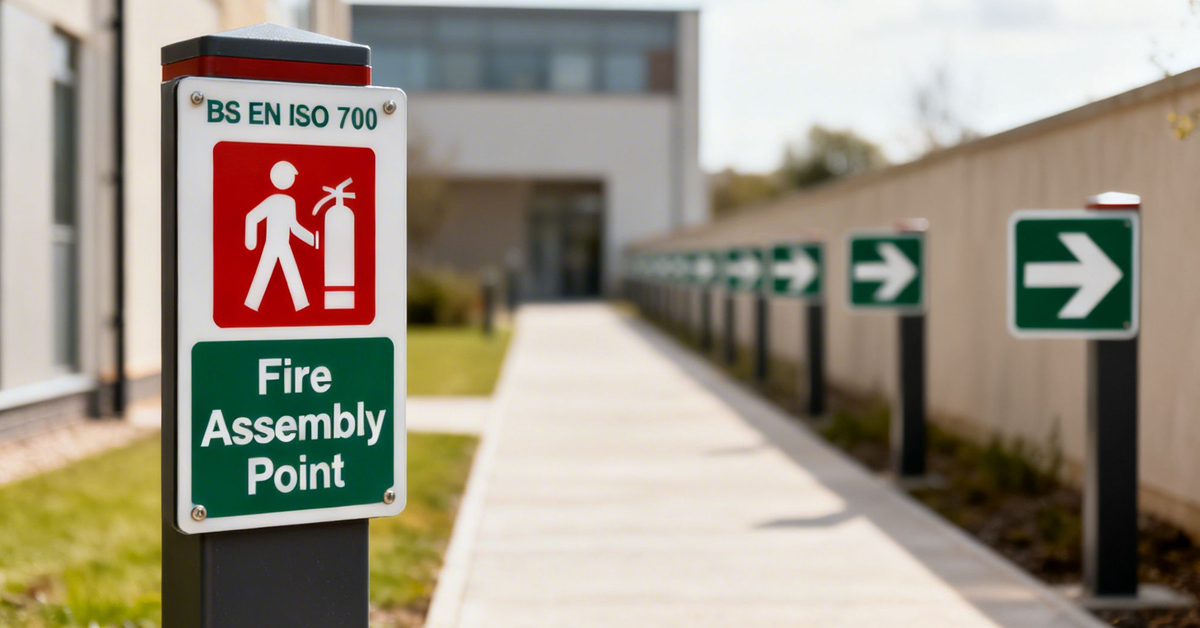
Without it, even the best-laid evacuation plans will fall apart under the pressure of a real emergency. The end goal is to make the route to safety an instinctive, almost automatic action for every single person in the building.
During a high-stress evacuation, your signage needs to provide instant recognition and clear direction. In the UK, that means sticking to specific standards designed for consistency and immediate understanding.
The key requirement for any fire assembly point sign is conformity with BS EN ISO 7010. This standard specifies the universally recognised green and white pictogram of stylised figures gathering at a central point. Using this symbol means anyone, regardless of what language they speak, can immediately grasp its meaning.
Beyond the symbol itself, think about these practical points:
Placing a single sign at the assembly point itself is nowhere near enough. Your signage needs to create a clear, unbroken path that guides people from the moment they step outside the building right to that designated place of safety.
Signs are a passive form of communication. They are crucial, but they must be backed up by active, ongoing efforts to make sure everyone is informed. This is where your procedures and training become vital.
The location of a fire assembly point should never be a secret that people only discover when an alarm is blaring. It has to be embedded into the routine safety information you provide to everyone who uses the building.
A fire drill is your single best opportunity to test your communication strategy. It reveals gaps in knowledge, highlights poorly understood routes, and shows whether your signage is truly effective in guiding people under pressure.
To ensure the location is known, you have to integrate it into all your relevant processes. This moves the information from a forgotten detail in a manual into active, usable knowledge. For more details on effective instruction, explore our guide on fire safety training for staff.
To ensure everyone is on the same page, your communication plan should have several layers, catering to different types of people in your building. A solid strategy ensures that everyone, from a new employee on their first day to a short-term visitor, knows exactly where to go.
Consider putting these measures in place:
By combining compliant, strategically placed signage with a persistent communication strategy, you transform your fire assembly point from a location on a map into an effective, life-saving tool. This proactive approach shows you take safety—and your legal duties—seriously.
Having a designated fire assembly point is the first step, but how you manage the human side of an evacuation is where a plan truly succeeds or fails. The ultimate goal is simple: get everyone to a place of safety in an orderly way, then get a swift and accurate headcount. This whole process relies on clear procedures and well-drilled people to stamp out panic and keep everyone safe during a critical incident.
The entire procedure hinges on preventing chaos. When the Fire and Rescue Service arrives, they need immediate, life-saving information. A disorganised, panicked crowd gives them nothing to work with, whereas an efficient muster provides the incident commander with a clear picture of who is safe and, more importantly, who might not be.
During an evacuation, your designated fire wardens (or fire marshals) are your eyes and ears on the ground. They are not expected to fight fires. Their job is to guide people to safety and ensure the whole procedure runs like clockwork. A calm, authoritative presence can make all the difference when tensions are high.
Their primary duties in getting people to the fire assembly point include:
These individuals are instrumental in turning a potential stampede into an orderly process, making the evacuation as swift and complete as possible.
Once everyone has gathered at the fire assembly point, the next critical task begins: the muster, or roll call. The purpose is straightforward but vital: to account for every single person who was believed to be in the building. This is the first thing an incident commander from the Fire and Rescue Service will ask for.
A successful muster depends entirely on having the right information ready to go. That means having access to up-to-date lists of everyone on the premises.
The single most important outcome of a muster procedure is to determine if anyone is unaccounted for. This intelligence directly informs the fire service’s search and rescue strategy, preventing them from risking lives to search for someone who is already safe.
To get this right, your procedure must be clear:
Discovering that someone is missing is a high-pressure moment. Your procedure must have a clear process for handling this information calmly and accurately. Panic is the enemy here; clear communication is your greatest asset.
If an individual cannot be found at the fire assembly point, the senior fire warden must immediately tell the Fire and Rescue Service incident commander.
The information you provide must be precise:
This specific, actionable intelligence allows firefighters to conduct a targeted search, focusing their efforts where they are most likely to be effective. It is a world away from a vague “we think someone might still be inside,” which forces crews into a much broader, more dangerous search. A well-managed muster is not just an admin task; it is a critical life-safety function.
Getting your fire safety procedures on paper is a great start, but it is just that—a start. Effective fire safety is not a one-off task you can tick off a list. It is an ongoing responsibility, a continuous cycle of reviewing, testing, and refining to make sure everything works when it matters most.
This is not just best practice; it is a core requirement of UK fire safety law. A plan that has not been tested under pressure is just a theory. And in a real emergency, you need certainty, not guesswork. This is where fire drills come in.
A fire drill is the only way to truly pressure-test your evacuation strategy. It takes your plan from a document tucked away in a folder and brings it to life, instantly showing you what works and, more importantly, what does not.
Drills are brilliant at exposing weaknesses you would never spot on paper:
Under the Regulatory Reform (Fire Safety) Order 2005, your fire risk assessment must be a living document. It needs a formal review at least annually, but also any time there is a significant change in your building or how it is used.
A fire risk assessment that sits gathering dust on a shelf is not compliant. It has to reflect the current reality of your building and its occupants to be worth the paper it is written on.
So, what counts as a “significant change”? Anything that could affect fire risk, including:
This simple process chart shows the key steps of mustering at the assembly point—the very procedure every fire drill should be testing.
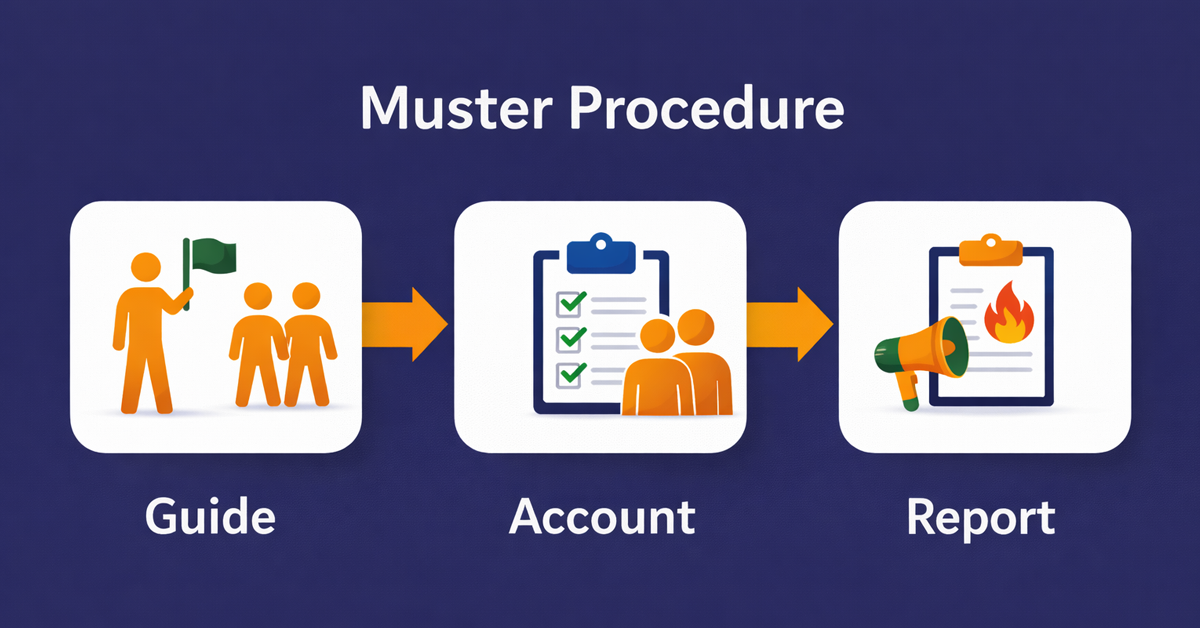
The flow is logical and straightforward: guide everyone out safely, account for every single person, and report the status to the emergency services. Regularly reviewing and drilling this process ensures your plan is not just compliant, but genuinely fit for purpose.
Here we tackle some of the most common questions that business owners, landlords, and property managers ask us about their fire assembly point responsibilities.
This is a great question, and the answer is not a simple yes or no. UK law, specifically the Regulatory Reform (Fire Safety) Order 2005, does not actually use the term ‘fire assembly point’.
Instead, it legally requires the ‘Responsible Person’ to establish and maintain a safe means of evacuation. For almost every business or multi-occupancy building, a designated assembly point is seen as a non-negotiable part of fulfilling that duty. It is the logical conclusion to an escape route and absolutely essential for accounting for everyone safely. A competent fire risk assessment will almost certainly confirm you need one.
There is no single, legally defined distance written in stone. The most important rule is that it must be a place of ‘total safety’, and what that means depends entirely on your building’s height, its construction, and what is immediately around it.
A widely accepted rule of thumb is to place it at least one and a half times the height of the building away. The idea behind this is to protect everyone from the dangers of radiant heat, thick smoke, and falling debris in a serious fire. Your professional fire risk assessment will pinpoint a suitable, safe distance for your specific property.
The real test for any assembly point is this: does it get people completely clear of all immediate dangers from the fire, including the chaos of arriving fire engines and other emergency vehicles?
Failing to have a well-managed and clearly communicated assembly point can have severe knock-on effects. During an emergency, it creates confusion and panic, often causing people to bunch together in unsafe areas right where they might obstruct firefighters.
Even more critically, it makes an accurate roll call impossible. This is a huge problem. It could force the Fire and Rescue Service to send crews into a dangerous, burning building to search for someone who is actually standing safely across the street. In the eyes of the law, this is a major failure in fire safety management and could easily lead to enforcement action, significant fines, or even prosecution.
Most HMO landlords I talk to can rattle off their fire door requirements, their alarm grade, and their emergency lighting checks without missing a beat....

Most of the fire safety advice on this site assumes you already have a working HMO. This one is for the stage before that: the...