
HMO Fire Door Regulations: A Plain English Guide for Landlords
17/02/2026
As a landlord or manager of a House in Multiple Occupation (HMO) in the UK, you are legally responsible for ensuring your property’s fire doors meet strict safety standards. This duty is laid out in the Regulatory Reform (Fire Safety) Order 2005. The standard you will most often encounter is the FD30 fire door—a door designed to hold back fire for a critical 30 minutes, giving your tenants the vital time they need to evacuate safely. This guide is for landlords, property managers, and anyone acting as the Responsible Person for an HMO, explaining what is required, why it matters, and the consequences of getting it wrong.
If you run an HMO, the law designates you as the ‘Responsible Person’. This is a formal title, and it means exactly what it sounds like: the fire safety of your tenants rests squarely on your shoulders.
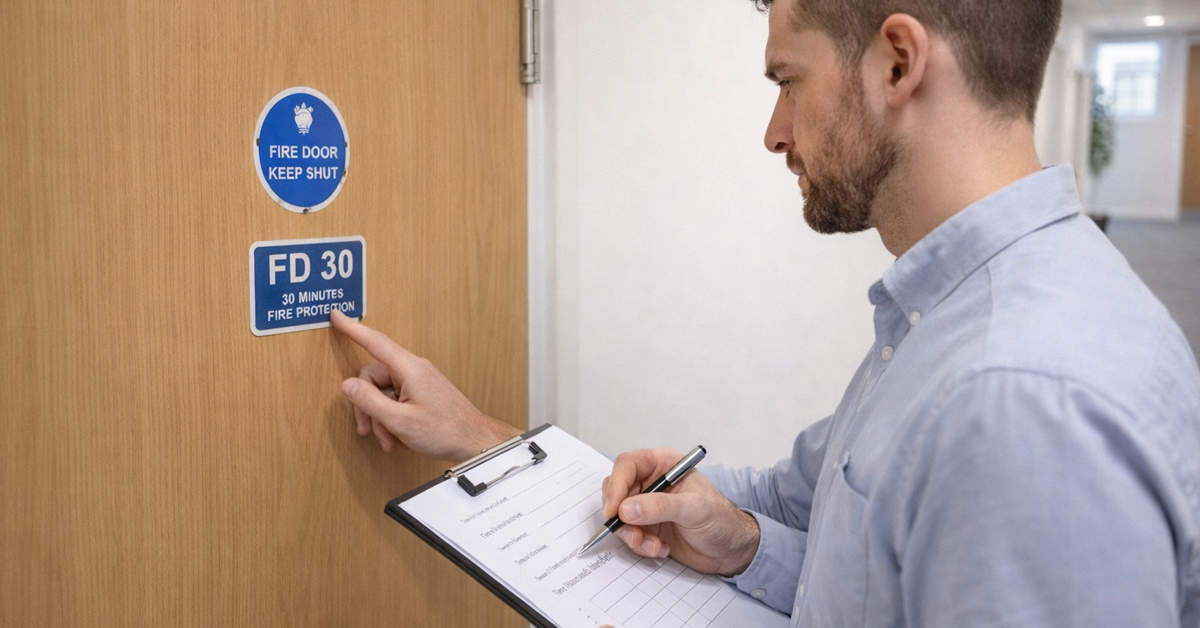
Compliant fire doors are not just a box to tick for building control. They are your first and best line of defence in a fire, a concept known as ‘compartmentation’. Think of your HMO like a ship with watertight compartments; if there’s a breach in one section, sealed doors stop the whole vessel from flooding. In your property, fire doors contain fire and deadly smoke to a single area, keeping hallways and staircases clear as protected escape routes.
In most HMO properties, the FD30 fire door is the minimum requirement. The ‘FD’ stands for Fire Door, and the ‘30’ signifies it can withstand fire for at least 30 minutes. This is not just about the door itself; it is the complete doorset—the frame, intumescent seals, smoke seals, and all the correct hardware working together. That 30-minute window is absolutely critical for allowing everyone to escape and for the fire and rescue service to arrive and take control.
However, a fire door is useless if it is not fitted or maintained correctly. Shockingly, the Fire Door Inspection Scheme (FDIS) found that a staggering 75% of UK fire doors fail to meet safety standards, with nearly a third (31%) compromised by improper installation alone. For an HMO landlord, this means you cannot afford to overlook the details. Self-closing devices must work every single time, and intumescent seals must be intact.
As the Responsible Person, you are legally accountable for ensuring every fire door in your property functions as intended. This duty is continuous and requires regular checks, not just a one-off installation.
Of course, your responsibilities do not stop at fire doors. Landlords also have critical legal duties around gas safety, which is just as important for protecting your tenants. It is worth familiarising yourself with what is involved in obtaining a Gas Safe Certificate to ensure you are compliant across the board.
Cutting corners on HMO fire door regulations can lead to devastating consequences, including unlimited fines in GBP (£) and even prosecution. Getting this right from day one is the only way to manage your risk and protect your tenants.
This is a critical question for every HMO landlord, and getting it wrong is perhaps the single most common compliance failure. Once you understand the principle behind the regulations, it becomes much simpler to assess your property and identify where fire doors are needed.
The entire strategy is based on two objectives: protecting the escape route and containing a fire where it is most likely to start. Think of your shared hallways and staircases as a protected tunnel. Your goal is to ensure that if a fire breaks out in any room, it cannot flood that tunnel with smoke and flames, trapping other occupants.
The most fundamental rule is this: any door that opens from a private room onto the shared escape route must be a fire door. This is the absolute backbone of your fire safety plan and it is completely non-negotiable.
This applies to doors leading from:
Every one of these doors must be a self-closing, FD30-rated fire doorset. This setup creates a solid 30-minute barrier, buying precious time and stopping a fire in one room from making the main escape route unusable for everyone else.
It is no surprise that some rooms carry a much higher fire risk than others. Shared kitchens are top of the list, containing cooking appliances, electrical equipment, and flammable materials like cooking oil. A fire can get out of control in a kitchen in seconds.
For that reason, any door leading from a shared kitchen directly onto the escape route must also be a compliant fire door. It is a critical layer of defence that contains the immediate danger, stopping lethal smoke and fire from pouring into the hallway while people are trying to get out.
In simple terms, you are building a protective bubble around the escape route. The fire doors are the essential building blocks of that bubble, separating the places people sleep from the places a fire is most likely to ignite.
To make it even clearer, I have put together a simple table summarising where fire doors are mandatory in a typical HMO. Use this as a checklist to walk around your own property and identify any gaps.
| Door Location | Is a Fire Door Required? | Common Standard | Key Considerations |
|---|---|---|---|
| A tenant’s bedroom onto a shared hallway | Yes, always | FD30 | This is a fundamental requirement for protecting sleeping occupants. |
| A shared kitchen onto an escape route | Yes, always | FD30 | Kitchens are a major source of ignition and must be contained. |
| A shared living room onto an escape route | Yes | FD30 | Any habitable room connected to the main exit path requires protection. |
| An internal bathroom door (no ignition risk) | No | N/A | Generally not required unless it contains ignition sources like a boiler. |
| A cupboard with electrical meters/fuse box | Yes | FD30 | These are sources of ignition and must be enclosed by a fire-resisting door. |
| Main entrance door to a flat in a larger block | Yes | FD30 or FD60 | The flat entrance door is crucial for protecting the building’s common escape routes. |
This table should give you a solid foundation for assessing your property. Remember, the goal is not just to tick boxes; it is to create a genuinely safe environment where every tenant has a clear and protected route to safety if the worst happens.
A compliant fire door is so much more than a slab of wood – it is a carefully engineered safety system where every single component plays a critical role. For any landlord or property manager navigating HMO fire door regulations, understanding these parts is non-negotiable. The failure of just one element can render the entire door useless in an emergency.
The most common rating you will encounter is FD30. The ‘FD’ simply stands for Fire Door, and the ’30’ tells you the door is certified to provide 30 minutes of fire integrity when installed correctly as a complete unit. That crucial half-hour is designed to hold back a fire, stop the spread of deadly smoke, and keep the escape route clear for your tenants.
It is a common mistake to think of a fire door as a single item. In reality, you must think of it as a complete ‘doorset’. This system is like a chain; it is only as strong as its weakest link. If any part is missing, damaged, or to the wrong specification, the door simply will not do its job.
The essential components of a compliant doorset include:
This diagram shows how these components work together to create protected zones within an HMO, separating higher-risk areas from escape routes.

You can see the principle of compartmentation in action here. Fire doors act as barriers, keeping private spaces like bedrooms safe from high-risk zones like kitchens, making sure the hallway remains a clear escape route.
The hardware, often called ironmongery, is the final piece of the puzzle. Every single component must be fire-rated and compatible with that specific doorset. Using standard, off-the-shelf hardware is a critical failure that instantly invalidates the door’s fire rating.
A fire door propped open is no longer a fire door. Its entire purpose is defeated. The self-closing device is arguably the most critical component for ensuring the door performs its function when needed.
Key hardware elements include:
The absolute necessity for these systems is backed up by official fire statistics, which consistently highlight the risks in multi-occupied buildings. In these properties, correctly functioning FD30 doors are the first and most vital line of defence.
You can read more about the technical details of HMO fire safety requirements on hmo-architects.com. By getting to grips with each component, you will be far better equipped to inspect your doors and make sure every part of that safety chain is intact.
Even the best, most expensive fire door is completely useless if it is fitted badly or left to fall into disrepair. In a fire, it is these seemingly small oversights that lead to catastrophic failure. As the Responsible Person, the buck stops with you. A compliant fire door is a complete engineered system; its life-saving performance depends entirely on getting the installation and ongoing maintenance right.
This is not a minor detail—it is a massive problem across the UK. A report from the Fire Door Inspection Scheme (FDIS) revealed that a staggering 75% of UK fire doors do not meet the required safety standards. Even more telling is that 31% of those failures were down to improper installation alone. The introduction of the Fire Safety Act 2021 has only increased the scrutiny, bringing flat entrance doors firmly into the scope of the Regulatory Reform (Fire Safety) Order 2005.
A fire door must be installed by a competent person—someone who genuinely understands the tiny tolerances and specialist components involved. A general builder or handyman, no matter how skilled, often lacks this niche expertise. Trying to cut costs here is a false economy that could have devastating consequences.
Some of the most common installation failures we see time and again include:
Think of a fire door installation like a prescription. You have to follow the manufacturer’s instructions to the letter. If you deviate from the tested and certified method, even slightly, you invalidate its life-saving potential and your legal compliance.
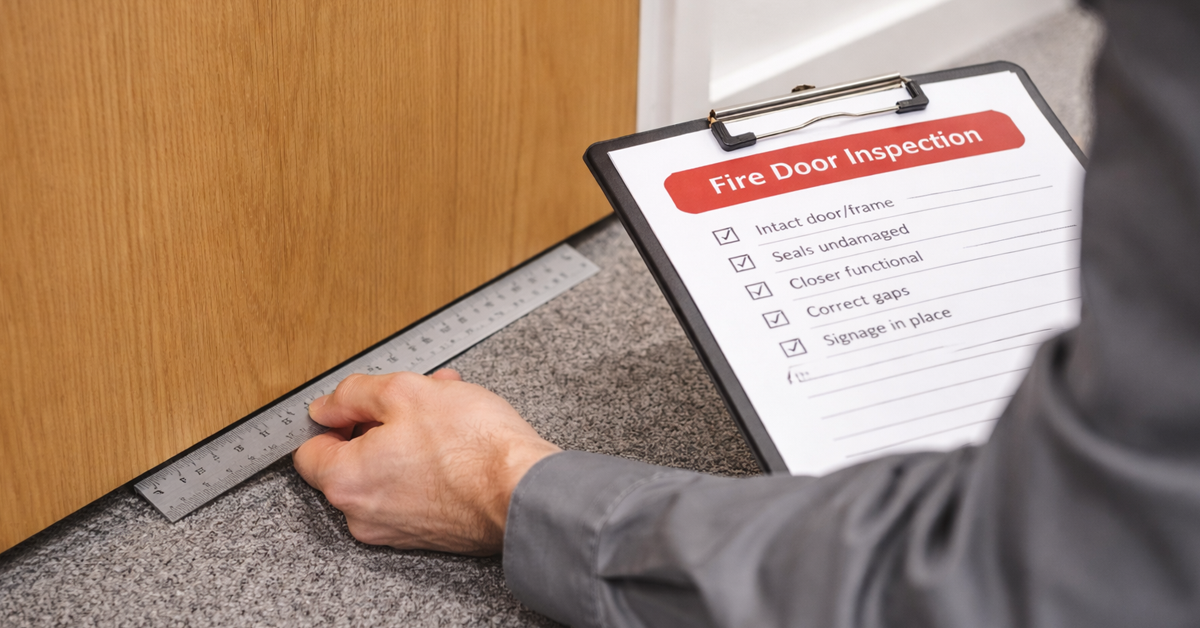
Under the Fire Safety Order, maintenance is not a one-off job; it is a continuous legal duty. Fire doors in an HMO get a lot of use and can take a real beating from daily wear and tear. A door that was perfectly compliant on day one can quickly become ineffective without regular checks.
Regular inspections are crucial for catching minor issues before they become major risks. We have put together a detailed guide to walk you through the process. Take a look at our guide on the fire door inspection checklist for a complete breakdown of what to look for.
A simple, routine check should be part of your normal property management. This is not just best practice—it is a fundamental requirement of your legal obligations under HMO fire door regulations.
Every time you visit your property, get into the habit of running through these quick but vital checks on each fire door. It only takes a few minutes per door and builds a solid record of your due diligence.
By embedding these simple checks into your management routine, you shift from a reactive to a proactive fire safety mindset. This does not just protect your tenants; it gives you tangible proof of your commitment to compliance if the authorities ever come knocking.
Think of your fire risk assessment as the master plan for your HMO’s safety. It is the single most important document you hold, proving you have actively identified fire risks and put the right measures in place to protect your tenants. This is not just good practice; it is a legal obligation under the Regulatory Reform (Fire Safety) Order 2005.
Within this vital document, your fire doors take centre stage. It is a common—and dangerous—misconception to think that just buying doors with an ‘FD30’ sticker on them is enough to tick the compliance box. Your fire risk assessment must formally document why these doors are suitable, their current condition, and how you maintain them. This creates a clear, auditable trail connecting the physical hardware in your property to your legal responsibilities.
When a competent fire risk assessor inspects your HMO, they do not just glance at the doors. They scrutinise each one as a complete system, looking beyond the label to evaluate its real-world performance in a fire.
A professional inspection will zero in on these key points:
The process starts with understanding the building’s layout. Knowing how to read a floor plan can be a huge help here, as it allows you to map out escape routes and pinpoint where every fire door is supposed to be.
Recent laws, especially the Fire Safety Act 2021, have only made this process more critical. The Act clarified that the Fire Safety Order applies to a building’s structure, external walls, and all common parts—explicitly including the front entrance doors to individual flats or rooms. This means your fire risk assessment must now specifically cover these doors in detail.
Your fire risk assessment is not a document you file and forget. It is a living record of your safety management. Every change, from installing a new fire door to repairing an existing one, must be logged and updated in the assessment.
The consequences for getting this wrong are becoming steeper. Fire and Rescue Services are increasing their inspection activities, and one of the most common breaches they find relates to Article 14 of the Fire Safety Order (emergency routes and exits), which is almost always linked to faulty or non-compliant fire doors.
Ultimately, your fire doors are a promise of safety to your tenants. Your fire risk assessment is the legally required proof that you are keeping that promise. To understand the full scope of what is involved, take a look at our guide to getting a fire risk assessment for an HMO.
It is easy to think of fire door regulations as just another piece of administrative burden, but ignoring them has severe, real-world consequences. This can have a direct impact on your finances, your freedom, and, most importantly, your tenants’ lives. Local authorities and Fire and Rescue Services have serious enforcement powers, and they are increasingly using them.
Cutting corners on fire safety is a gamble you cannot afford to take. Understanding the penalties is not about fear-mongering; it is about protecting your business, your tenants, and avoiding personal liability.
If a council or fire officer inspects your HMO and finds a problem with your fire doors, they will not just leave a polite note. They have a range of legal powers designed to compel you to fix the issues, and the situation can escalate quickly.
The process usually unfolds like this:
These notices are not suggestions. They are legal commands designed to protect tenants, and ignoring them will lead to much more serious consequences.
The financial penalties for breaching the Fire Safety Order are designed to be a serious deterrent. Fines are unlimited and can be brought against you personally, not just your limited company. This means your home, savings, and other personal assets are on the line.
The courts take an extremely dim view of landlords who put profit before safety. A breach of fire safety regulations is treated as a serious criminal matter, not a minor administrative slip-up.
In the worst-case scenarios, especially where negligence leads to a serious injury or death, the consequences go beyond money. As the Responsible Person, you could face prosecution, a criminal record, and even a prison sentence.
The law is structured to hold individuals accountable when they fail in their duty to provide a safe home. The only reliable way to protect your tenants, your investment, and yourself is to achieve and maintain compliance.
Getting to grips with fire door regulations can feel complex. It is one thing to read the rules, but another to know what they look like in practice. Here are the answers to some of the most common questions we receive from landlords and property managers.
The law requires ‘regular’ checks, which can be an unhelpful term. However, best practice and recent fire safety legislation provide a much clearer picture. As the Responsible Person, you should be carrying out quick visual checks yourself at least once a month.
In addition, you should engage a competent, qualified professional for a much more detailed inspection at least every six months. This two-tier approach—your constant vigilance combined with expert verification—creates a robust safety routine.
This is one of the most frequent—and dangerous—mistakes seen in HMOs. A certified fire door is not just the door leaf. It is an entire engineered system, or ‘doorset’, that includes the door leaf, the frame, and all the hardware (hinges, latches, closers, seals), all tested together to resist fire.
Fitting a new fire door into an old, non-rated frame will almost certainly invalidate its fire rating. The complete assembly will not provide the 30 minutes of protection you are legally required to have, and it will be flagged as non-compliant during any professional inspection or fire risk assessment. You should always replace the entire doorset with a compatible, certified unit.
Good record-keeping is not just good practice; it is your legal proof that you are fulfilling your duties. Every action you take related to your fire doors must be documented in your fire safety logbook or as part of your fire risk assessment records.
This is not optional. Your documentation needs to include:
This creates a clear audit trail that proves to the local council or the Fire and Rescue Service that you are proactively managing fire safety.
Keeping meticulous records is your primary defence if your compliance is ever questioned. It demonstrates you have an active and organised system for managing fire safety, rather than just reacting to problems.
While they are not mandatory in every location, installing fire doors with certified, fire-rated glass vision panels is a very sensible measure, especially along escape routes. For hallways, staircases, and corridors, they are invaluable.
Vision panels help prevent collisions, particularly during an emergency evacuation. More importantly, they allow tenants to see if the escape route ahead is clear of smoke or fire before they open the door. It is a simple feature that could be a lifesaver.
Ensuring your fire doors are correctly specified, installed, and maintained is one of the most fundamental duties of an HMO landlord. If you need professional assurance that your property meets all legal standards, the team at HMO Fire Risk Assessment can help. We provide expert, certified fire risk assessments to give you complete peace of mind. Contact us today to secure your compliance at https://hmofireriskassessment.com.
Most HMO landlords I talk to can rattle off their fire door requirements, their alarm grade, and their emergency lighting checks without missing a beat....
Most of the fire safety advice on this site assumes you already have a working HMO. This one is for the stage before that: the...