

10 Key Types of Fire Detection Systems for UK Properties
13/02/2026
For business owners, landlords, and property managers in the UK, navigating the complexities of fire safety is a critical responsibility. The Regulatory Reform (Fire Safety) Order 2005 places the duty squarely on the ‘Responsible Person’ to ensure premises are safe, and a fundamental part of this is selecting, installing, and maintaining the correct fire detection and alarm system. An inadequate or poorly chosen system not only endangers lives but can also lead to severe legal and financial consequences, including unlimited fines and prosecution.
This comprehensive guide is designed for decision-makers managing commercial properties, residential blocks, and Houses in Multiple Occupation (HMOs). It cuts through the technical jargon to provide a clear, practical roundup of the primary types of fire detection systems available today. We will detail how each technology works, its ideal applications, and its specific pros and cons in real-world scenarios.
By the end of this article, you will have a solid understanding of the different detection methods available, from common ionisation and optical smoke alarms to advanced aspirating and flame detection technologies. This knowledge will empower you to make more informed choices that align with your legal duties and the specific findings of your property’s fire risk assessment. Our goal is to equip you with the insights needed to reduce risk effectively, ensure robust compliance, and protect both people and property with confidence.
Ionisation smoke detectors are one of the most common types of fire detection systems found in UK residential properties, particularly in older houses in multiple occupation (HMOs) and purpose-built student accommodation. They have been a cost-effective staple for achieving basic fire safety compliance for many years.
These detectors operate using a small, safe amount of radioactive material (Americium-241) positioned between two electrically charged plates. This material ionises the air within a sensing chamber, creating a small, continuous electrical current. When smoke particles from a fire enter this chamber, they disrupt the flow of ions and reduce the current. This drop in current is detected by the device’s internal circuitry, which then triggers the alarm.
Because of this mechanism, ionisation detectors are particularly sensitive to small smoke particles produced by fast-flaming fires, such as those involving paper, wood, or flammable liquids.
Ionisation alarms are best suited for areas where fast, open flames are a primary risk. They are a common sight in the communal areas of UK properties, including:
However, they are prone to nuisance alarms from cooking fumes or steam, making them unsuitable for placement near kitchens or bathrooms. This has led to a decline in their use in favour of other detector types.
Key Consideration: While once ubiquitous, the prevalence of false alarms has led many fire safety professionals and modern guidance, such as BS 5839-6, to recommend optical or multi-sensor alarms as a more reliable alternative, especially near kitchens.
Optical smoke detectors, also known as photoelectric detectors, are a highly effective and increasingly common type of fire detection system in UK properties. They are widely recommended by fire safety professionals for their reliability in detecting the most common types of domestic fires and for their reduced susceptibility to nuisance alarms compared to ionisation models.
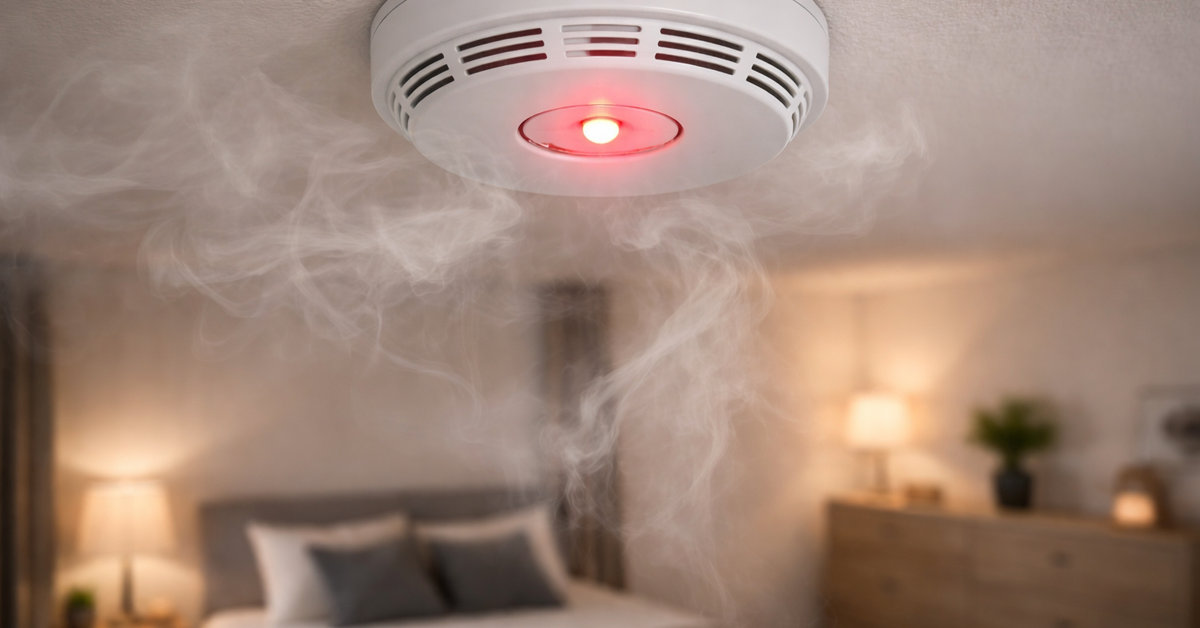
An optical detector operates using an infrared light beam within a sensing chamber. Under normal, smoke-free conditions, this light beam is directed away from a photosensitive sensor. When larger smoke particles from a smouldering fire enter the chamber, they scatter the light. This scattered light is then picked up by the sensor, which triggers the alarm.
This mechanism makes optical detectors exceptionally good at identifying slow-burning, smouldering fires. These are the types of fires often associated with furnishings like sofas, bedding, or overloaded electrical circuits, which produce large, visible smoke particles long before open flames appear.
Due to their sensitivity to smouldering fires, optical alarms are the preferred choice for living areas and circulation spaces within residential properties. Their application is mandated in many scenarios under UK fire safety guidance. Common locations include:
While more resistant to cooking fumes than ionisation detectors, they should still be positioned away from kitchens and bathrooms to prevent false alarms from steam.
Key Consideration: Current UK guidance, including the updated BS 5839-6:2019 standard, strongly recommends the use of optical or multi-sensor alarms in circulation areas of residential properties, such as hallways and landings, moving away from the use of ionisation detectors in these locations.
Heat detectors are a vital component in many fire detection systems, particularly in environments where traditional smoke detectors would be unreliable. Instead of sensing smoke, they are designed to react to a significant increase in temperature, making them ideal for areas with high levels of dust, fumes, or humidity. They are a common solution for avoiding nuisance alarms in specific locations within both residential and commercial properties.
Heat detectors trigger an alarm when they detect a rapid rise in temperature or when the ambient temperature exceeds a pre-set threshold. There are two primary types:
Many modern heat detectors combine both technologies for enhanced reliability.
The key advantage of heat detectors is their immunity to non-fire related particles. This makes them perfectly suited for environments where smoke, steam, or dust are normal. Typical UK applications include:
Key Consideration: Heat detectors are not a replacement for smoke detectors in circulation spaces like hallways or landings. They respond more slowly than smoke detectors to smouldering fires and should only be used in the specific environments for which they are designed as part of a comprehensive fire detection system.
Multi-sensor detectors represent a significant advancement in fire detection technology, combining two or more sensing elements into a single unit to provide a more reliable and comprehensive response. Also known as dual-technology alarms, they are increasingly specified in UK properties like HMOs and new-build residential blocks where a higher standard of fire safety is required.
These sophisticated devices typically integrate an optical (photoelectric) sensor with a thermal (heat) sensor. The alarm’s internal software uses an algorithm to analyse the input from both sensors. This dual-logic approach means it can detect a wide range of fire types, from the slow, smouldering fires that produce large smoke particles (picked up by the optical sensor) to fast-flaming fires that generate a rapid increase in temperature (detected by the thermal sensor).
An alarm is triggered only when one sensor reaches a high threshold or when both sensors detect lower-level indicators simultaneously. This intelligent verification process makes them far less susceptible to false alarms from non-fire sources like cooking fumes or steam, which might trick a single-sensor device.
Due to their versatility and reliability, multi-sensor detectors are ideal for complex environments and are recommended for providing robust protection in modern UK residential settings. Common applications include:
Key Consideration: The latest revision of BS 5839-6:2019+A1:2020 strongly recommends multi-sensor technology for circulation areas like hallways and landings in domestic properties to reduce false alarms and provide the broadest detection coverage.
Aspirating Smoke Detection (ASD) systems represent a highly advanced and sensitive form of fire detection, often used in environments where early warning is critical or where standard point detectors are impractical. Instead of waiting for smoke to reach a detector, ASD systems proactively draw air samples from the protected area through a network of small, discreet pipes.
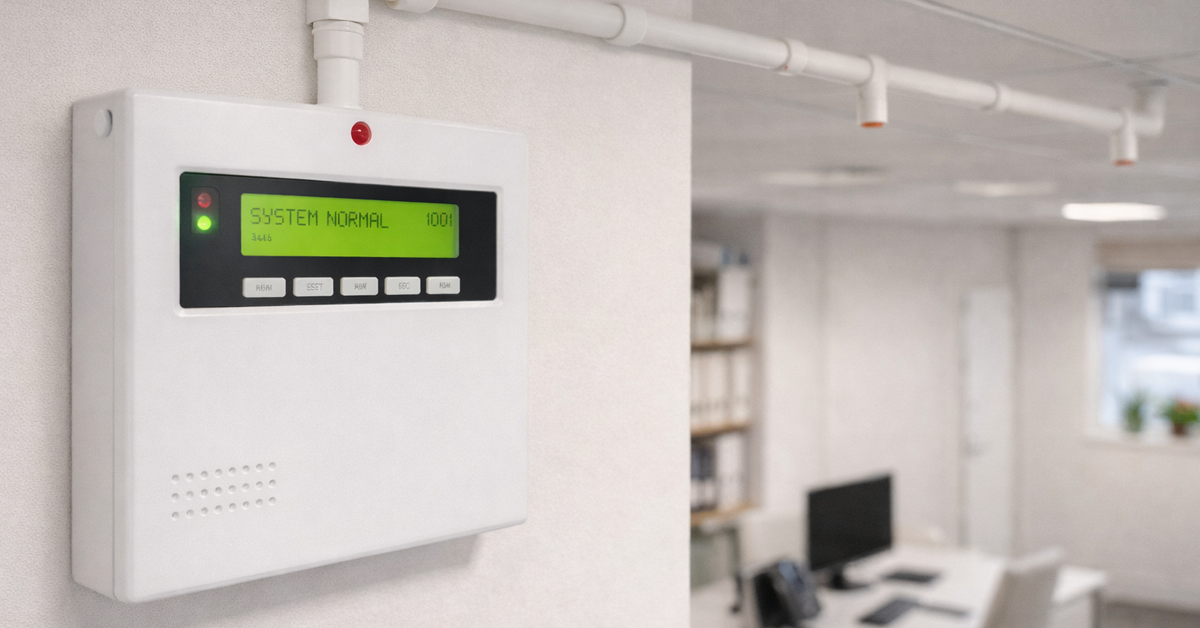
An ASD system uses a high-efficiency aspirator (a fan unit) to continuously pull air samples into a central detection unit via a network of purpose-built sampling pipes. These pipes have small, precisely drilled holes along their length, positioned to sample air from the desired locations. Inside the central unit, the air is filtered before passing through a highly sensitive laser or LED detection chamber that analyses it for the presence of even minute smoke particles.
This method allows for the detection of smoke at the very earliest stage of a fire, often long before it becomes visible to the human eye. The sensitivity can be configured to different levels, providing alerts ranging from “incipient fire” to full alarm conditions.
Due to their high sensitivity and installation flexibility, ASD systems are one of the premium types of fire detection systems. They are ideal for complex, high-value, or heritage properties where aesthetics and early intervention are paramount. Examples include:
Key Consideration: ASD is a specialist solution. Its design and installation require expert knowledge from qualified fire engineers. It is not a DIY-friendly system and is typically reserved for properties where the risk, value, or architectural complexity justifies the significant investment.
Flame detectors represent a specialised category of fire detection systems, engineered for high-risk commercial and industrial environments rather than typical residential settings. They provide an exceptionally rapid response by sensing the specific radiation signatures emitted by open flames, often triggering an alarm in milliseconds.
Unlike smoke or heat detectors that wait for by-products of combustion to reach a sensor, flame detectors are line-of-sight devices. They use optical sensors to analyse electromagnetic radiation, specifically in the ultraviolet (UV) and infrared (IR) spectrums. A fire’s flame emits radiation at particular wavelengths, and when the detector’s sensor identifies this specific pattern, it immediately initiates an alarm.
This technology allows them to detect fires almost instantaneously, making them ideal for situations where flammable materials could lead to rapid fire development. The most advanced units combine UV and IR sensors to improve reliability and reduce the likelihood of false alarms from other radiation sources.
Flame detectors are almost exclusively deployed in high-hazard zones where the primary risk is a fast-developing, open-flame fire. They are not a substitute for smoke or heat detection in residential areas. Typical UK applications include:
Their high sensitivity means careful placement is essential to avoid false activations from sources like sunlight, welding arcs, or halogen lamps.
Key Consideration: Flame detectors are a supplementary system for specific, identified hazards. A fire risk assessment should explicitly justify their use, ensuring they are combined with appropriate smoke and heat detection to cover smouldering fires, which do not produce significant flame.
Although not technically a fire detector, a carbon monoxide (CO) detector is an essential life-safety device that is legally mandated in many UK properties. It is designed to detect the presence of carbon monoxide, an invisible, odourless, and highly toxic gas produced by the incomplete combustion of carbon-based fuels like gas, oil, coal, and wood. Its inclusion in a fire safety strategy is critical for protecting occupants from poisoning.
Most modern CO alarms use an electrochemical sensor. Inside the device, a chemical solution reacts with any carbon monoxide gas that enters the sensor chamber. This chemical reaction generates a small electrical current, the strength of which is proportional to the amount of CO present. When the current reaches a pre-set danger level, indicating a hazardous concentration of the gas, the device’s internal circuitry triggers a loud, distinct alarm.
This mechanism allows the detector to alert occupants to a CO leak from faulty appliances like boilers, gas fires, or cookers long before the levels become fatal.
CO detection is a legal requirement in many residential settings and is considered best practice across the board where fuel-burning appliances are present. Common applications include:
Their role is purely to detect CO gas, not smoke or heat, so they must always be installed in addition to, not instead of, appropriate fire detectors.
Key Consideration: The legal requirements for CO alarms are strict and differ slightly across the UK. Landlords and property managers must ensure they are compliant with the specific regulations for England, Scotland, Wales, and Northern Ireland to avoid significant penalties.
The latest evolution in fire detection technology, wireless and smart systems offer unparalleled flexibility and remote management capabilities. These systems use radio frequency (RF) mesh networks to interconnect devices without the need for disruptive and costly wiring, making them an ideal solution for retrofitting existing properties or protecting buildings where structural alterations are restricted.
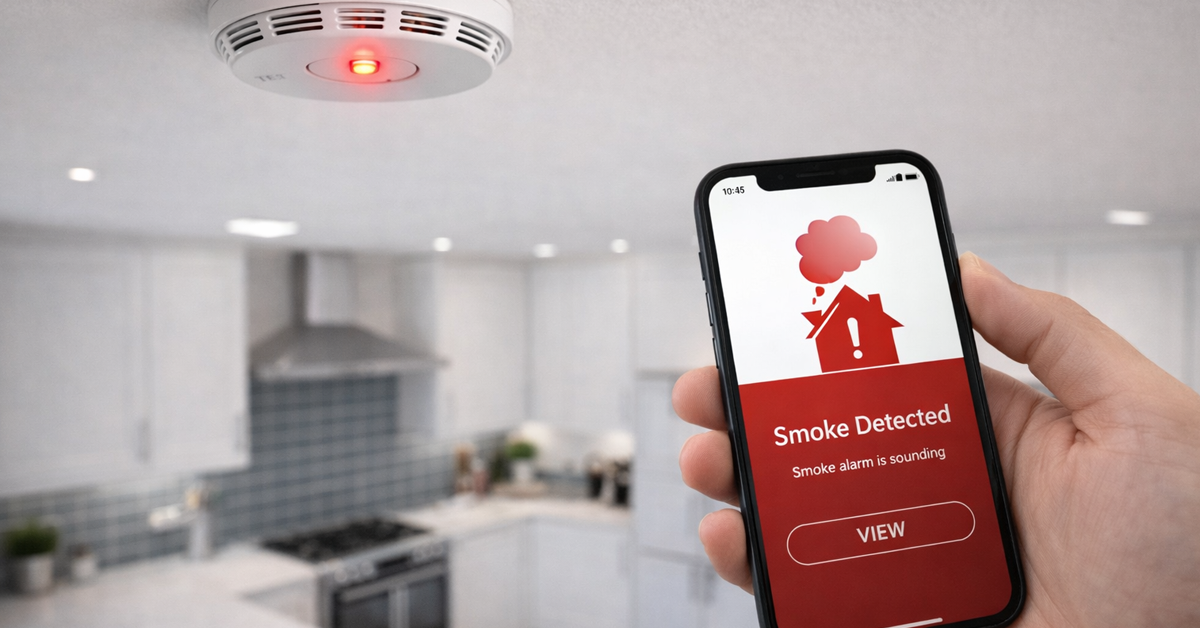
Wireless detectors, like those from leading UK manufacturers, communicate with each other via secure RF signals. When one alarm detects a fire, it sends a signal to all other interconnected units, ensuring an alert is sounded throughout the entire property. This creates a robust safety net, which is crucial in larger or multi-level buildings. For comprehensive protection in modern properties, understanding the advantages of systems like wireless interconnected fire alarms is crucial.
Smart functionality adds an IP-based layer. This connects the system to the internet via a hub or directly through Wi-Fi, enabling remote notifications, system status checks, and silent testing via a smartphone app. This provides landlords and property managers with real-time oversight from any location.
The absence of wiring makes these systems perfect for challenging installations. They are increasingly specified for:
Key Consideration: The upfront cost of wireless and smart detectors can be higher than traditional hardwired units. However, this is often offset by significantly reduced installation costs, labour time, and the avoidance of redecoration expenses, making it a highly cost-effective solution for many types of fire alarm systems.
Manual fire alarm activation, commonly known as a break-glass call point, is a fundamental component of most commercial and multi-occupancy fire safety systems. Unlike automatic detectors that react to smoke or heat, these devices rely on human intervention, allowing occupants who spot a fire to trigger a building-wide alarm immediately. They are a critical, proactive element in a comprehensive fire detection strategy.
Manual call points are simple yet effective devices. Traditionally, they required a user to physically break a small glass panel to activate a switch inside, which completes an electrical circuit and signals the main fire alarm control panel to sound the alarm. Modern versions often use a resettable plastic element that deforms or drops when pressed firmly, which can be easily reset with a special key after an activation.
This direct activation bypasses the need for smoke or heat to build up and reach a sensor, often providing the earliest possible warning of a fire, especially if it is discovered before an automatic detector has had a chance to react.
The installation of manual call points is a legal requirement in the communal areas of almost all non-domestic premises and larger Houses in Multiple Occupation (HMOs) under UK fire safety legislation. Their placement is crucial for effective use during an evacuation. Typical locations include:
Key Consideration: Manual call points empower occupants to take decisive action. They are not an alternative to automatic detection but a vital supplement, ensuring an alarm can be raised the moment a fire is visually confirmed, which can be critical in accelerating an evacuation.
While not a detection system in itself, the integration of emergency lighting and escape route signage with a fire alarm system is a critical component of a building’s overall life safety strategy. This integrated approach ensures that when a fire is detected, occupants are not only alerted but are also provided with a clearly illuminated and signed path to safety, which is essential for compliance in UK properties like HMOs and commercial buildings.
Emergency lighting and signage are connected to the building’s main fire alarm panel. When any detection device (such as a smoke or heat detector) is activated, the system automatically triggers the emergency lights and illuminated signs along the designated escape routes. This ensures that even in a power failure or in conditions of thick smoke, corridors, stairwells, and final exits remain visible, preventing panic and guiding occupants to safety. This is a fundamental requirement under UK building regulations and fire safety law.
This system is one of the most important complementary safety features for fire detection systems, transforming an alarm from a simple warning into a guided evacuation plan.
Integrated emergency lighting is mandated in many environments to ensure safe egress, particularly where escape routes are complex or could become dark during an incident. Key examples include:
Key Consideration: For landlords and property managers, ensuring the correct type of lighting (maintained vs. non-maintained) is installed and functioning is not just a best practice; it’s a legal obligation. A fire risk assessment will specify the exact requirements for your premises.
| Detector / System | ???? Implementation complexity | ⚡ Resource requirements | ⭐ Expected outcomes | ???? Ideal use cases | ???? Key advantages / tips |
|---|---|---|---|---|---|
| Ionisation Smoke Detectors | Low: simple install, battery or mains | Low cost; routine battery changes; radioactive disposal needs | ⭐⭐: rapid for fast-flaming fires, poor for smouldering | Open-plan HMOs, hallways, cost-sensitive installs | Cost-effective, long life; test monthly, replace batteries annually |
| Optical Smoke Detectors (Photoelectric) | Low–Medium: straightforward; interconnect options | Moderate cost; mains with battery backup; periodic cleaning | ⭐⭐⭐⭐: strong for slow-smouldering fires, fewer false alarms | Bedrooms, living areas, HMOs with textiles/furniture | Best for bedrooms; combine with ionisation for mixed-risk coverage; clean lenses annually |
| Heat Detectors (Thermal) | Low: simple fit but placement critical | Low cost; minimal cleaning; suitable for harsh environments | ⭐: detects later heat stages; reduces nuisance alarms | Kitchens, garages, boiler rooms, utility areas | Use in kitchens to avoid steam alarms; position centrally on ceiling |
| Multi-Sensor (Dual-Technology) | Medium: integrated device, some system configuration | Higher upfront cost; mains + battery backup; skilled servicing | ⭐⭐⭐⭐: broad detection across flame and smoulder; fewer false alarms | Shared HMO hallways, bedrooms, mixed-use areas | Comprehensive coverage; train maintenance staff and document in FRA |
| Aspirating Smoke Detection (ASD) | High: specialist design, tubing routing and commissioning | Very high cost (3–5×); specialist maintenance and calibration | ⭐⭐⭐⭐: extremely early detection at very low particle levels | Heritage/listed HMOs, large complex or high-value properties | Use only for complex/heritage sites; engage specialists; plan tubing early |
| Flame Detectors (UV / IR) | Medium: precise aiming and clear line-of-sight required | Moderate–high cost; targeted deployment for high-risk zones | ⭐⭐⭐⭐: millisecond detection of open flames; not for smouldering | Commercial kitchens, workshops, outdoor/loading areas in mixed-use sites | Fast for open flames; avoid false alarms from bright lights; use alongside smoke/heat detectors |
| Carbon Monoxide (CO) Detectors | Low: simple install, battery or mains | Low cost; required where fuel-burning appliances present | ⭐: detects life‑threatening CO gas (not fire) | Properties with gas boilers/cookers; bedrooms and living areas | Legally required with fuel appliances; position 1–3 m from sources; monthly tests |
| Wireless & Smart Fire Detection Systems | Medium: RF/site survey, hub configuration | Higher per-unit cost; batteries; Wi‑Fi/internet; possible subscriptions | ⭐⭐⭐: flexible coverage, remote alerts, scalable | Listed buildings, retrofit HMOs, multi-property portfolios | Minimal wiring, remote monitoring; perform RF/Wi‑Fi surveys and schedule battery/software upkeep |
| Manual Fire Alarm Activation (Break‑Glass Call Points) | Low–Medium: wired to central alarm, simple devices | Low unit cost but requires alarm system integration | ⭐⭐: immediate occupant-initiated alarm; no early detection | Communal areas, stairwells, major escape routes in HMOs | Required by standards; install within 5 m of escape routes; include in drills and tenant induction |
| Emergency Lighting & Escape Signage Integration | Medium–High: design, electrical install and integration | Capital cost and regular maintenance/testing; specialist install | ⭐⭐⭐: critical for safe evacuation and compliance | Corridors, stairwells, basements, low-light escape routes | Mandatory for escape routes; design professionally, quarterly tests and annual duration test |
Navigating the diverse landscape of fire detection systems can seem complex, but understanding the core principles behind each type demystifies the process. As we have explored, the right solution is rarely a single device. Instead, it is a carefully orchestrated system designed to address the unique fire risks present within a specific environment. From the rapid response of an ionisation detector to a smouldering fire to the resilience of a heat detector in a dusty workshop, each technology has a distinct and valuable role.
The key takeaway is that system selection is not an off-the-shelf decision. A system that provides robust protection for a residential block may be entirely inadequate for a commercial kitchen or a heritage property with irreplaceable assets. The choice between optical, heat, multi-sensor, and more specialised types of fire detection systems must be directly informed by the activities, materials, and occupant vulnerabilities within your premises. This strategic approach ensures not just compliance, but genuine, effective life safety protection.
The journey from understanding these technologies to implementing a compliant system is bridged by one critical, non-negotiable process: the Fire Risk Assessment. This is the cornerstone of your legal duties under the Regulatory Reform (Fire Safety) Order 2005.
A professional fire risk assessment translates legal obligations into a practical, actionable checklist. It removes the guesswork from selecting the right types of fire detection systems, ensuring your investment is targeted, effective, and fully defensible during an inspection by the Fire and Rescue Service.
Once installed, your fire detection system becomes a critical life safety asset that demands diligent management. A state-of-the-art system is only reliable if it is properly maintained and regularly tested. This includes routine user checks, scheduled engineer servicing, and keeping a detailed logbook of all activities. In situations where a system must be taken offline for maintenance or repair, you must implement interim measures to maintain safety. For instance, understanding what a fire watch entails is crucial for ensuring continuous monitoring and fulfilling your legal duties during system downtime.
Ultimately, mastering the types of fire detection systems is about more than just technology; it is about proactive risk management. By grounding your decisions in a thorough risk assessment and committing to a robust maintenance schedule, you move from simply meeting minimum standards to creating a genuinely safe environment. This proactive stance is the hallmark of a responsible duty holder, providing peace of mind and demonstrating an unwavering commitment to protecting lives and property.
For landlords and managers of Houses in Multiple Occupation, navigating these requirements is a specific and critical responsibility. If you need expert guidance to ensure your property’s fire detection system is fully compliant and tailored to its unique risks, explore our HMO Fire Risk Assessment service. We provide a comprehensive evaluation and clear, actionable report to help you meet your legal obligations. HMO Fire Risk Assessment
Most HMO landlords I talk to can rattle off their fire door requirements, their alarm grade, and their emergency lighting checks without missing a beat....

Most of the fire safety advice on this site assumes you already have a working HMO. This one is for the stage before that: the...